
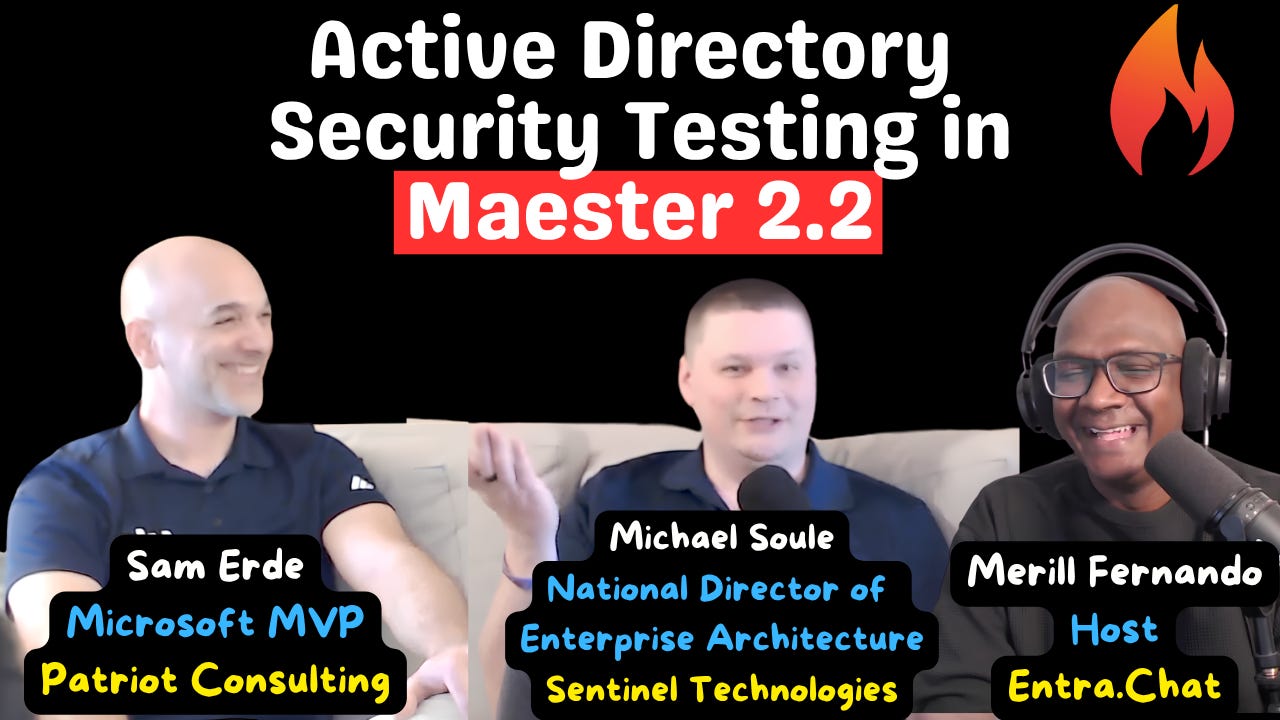
Active Directory Security Testing in Maester 2.2
Show notes
Active Directory is not dead. It is nearly thirty years old, Microsoft is still shipping new capabilities and new telemetry for it, and most of the forests running today will outlive the people currently administering them. What has changed is that you can now test it the same way you test your cloud tenant.
Maester, the open-source PowerShell testing framework, added Active Directory coverage: 269 opt-in checks across 19 areas, from users, groups, computers and service principal names through GPO state, DACLs, DNS, trusts, replication and schema. They run against your domain, not your tenant, and they are off unless you explicitly connect to Active Directory.
Mike Soule, who wrote and validated that test suite, and Sam Erde, Microsoft MVP and author of DLLPickle, join Merill at HIP Conf in Nashville to go through what the tests cover, how to run them safely, and where the project is heading.
Sponsored by:
Is Each App in Entra ID Still Worth Governing?
App registrations and enterprise applications accumulate. Owners change. Projects and pilots end. Credentials linger. And stale or unused apps and their permissions can continue adding risk and governance overhead long after their purpose is gone.
ENow App Governance Accelerator helps you understand what’s in your Entra ID application estate, who owns it, which apps, permissions, and credentials need attention, and what can safely be cleaned up to reduce your attack surface on a continuous basis as your tenant grows and changes.
Get the visibility and automated workflows you need to investigate application lifecycles at scale, clear out stale apps, and stop wasting time governing applications that shouldn’t still be there in the first place.
Operational health is not the same as a security finding
The design decision that makes these tests usable is the split between operational patterns and security controls. Six groups nested in a row is not a vulnerability. Nesting is an intentional, functional capability. It is also nearly impossible to reason about when you are trying to work out where a permission actually comes from, and that is how incidents happen.
So not every test is pass/fail. Some exist to be investigated and monitored, and Maester’s tagging lets you baseline them and watch whether an anti-pattern is spreading or receding over time. The underlying guidance is a blend: years of health checks across dozens of forests, community research from teams like Semperis and SpecterOps, and Microsoft’s own documentation — which, for a product people keep declaring dead, is currently some of the best documentation and logging Microsoft ships. The new NTLM auditing in Windows Server is the example: the who, the why and the where of every NTLM authentication, instead of replaying events and correlating them yourself.
Maester is not trying to replace the likes of PingCastle, Purple Knight or Locksmith. Those tools offer real value, and the conversation now is about bringing those perspectives into one central platform.
The permissions you actually need
Everything the AD tests do is read-only. A plain domain user gets a surprising amount, because a directory is built to be readable — you will simply get a subset of the tests. The full set needs tier-zero read access, because some tests reach objects in the configuration container. In a tiered environment, that means running as a tier-zero admin from a privileged admin workstation.
Interactively, there is nothing to set up beyond line of sight to a domain controller, the ActiveDirectory module and PowerShell. The AD tests are excluded by default and have to be requested by tag. For automation, run a local runner, or give a container runtime a path back to a domain controller. Today the tests run as the logged-in user’s domain credentials; alternate credentials and group managed service accounts are on the road map.
Tiering, ESAE and the enterprise access model
There are no explicit tiering tests yet, but they are coming now that Microsoft has published implementation guidance. The history is worth knowing. ESAE — the Enhanced Security Admin Environment, the red forest — solved a real problem: inside Active Directory, a domain admin is trusted implicitly, so the source of authority needs to sit somewhere that is not self-referential. A separate management forest achieves that, at a cost in operational complexity that most organisations could not sustain. Microsoft has since moved to the enterprise access model, and in practice most teams landed in the middle: tiering based on access control, with tier zero for core identity infrastructure, tier one for servers, databases and applications, and tier two for workstations and the workforce.
The advice is not all-or-nothing. Any amount of effort you put into tiering is a good investment. Where Maester helps is codifying Microsoft’s recommended implementation as tests you can actually check yourself against, including the DACL and inheritance anti-patterns that accumulate through ordinary operations.
What is coming next
The dependency on the ActiveDirectory PowerShell module is on its way out. Almost all of this work is LDAP-level, so a .NET-based approach covers the vast majority of tests with no module dependency — which opens up Linux, macOS and non-domain-joined machines. Multi-domain aggregation is in progress; today a run covers a single domain at a time. And Maester 3 is being planned around a new engine for the built-in tests, with multi-threading and parallel execution, licensing handled centrally instead of inside every test, and Pester retained for backward compatibility and custom tests.
Subscribe with your favorite podcast player or watch on YouTube
About Michael Soule
Mike Soule is a Maester co-maintainer and National Director of Enterprise Architecture at Sentinel Technologies, where he works with enterprise customers on identity, cloud and security. He wrote and validated the Active Directory test suite that shipped in Maester 2.2 — 269 opt-in checks across 19 areas — and has been the project’s leading test contributor since the night after Maester’s launch talk at the PowerShell Conference, when he turned up the next morning with roughly thirty CISA tests already written.
LinkedIn - https://www.linkedin.com/in/mikesoule/
GitHub - https://github.com/soulemike
About Sam Erde
Sam Erde is a Maester co-maintainer and a Microsoft MVP, working at Patriot Consulting. He has spent more than twenty years in PowerShell, Active Directory, Group Policy, Exchange and Microsoft 365, contributes to open-source defensive tooling including Locksmith, and wrote DLLPickle, the module that gets you out of assembly version conflicts when several Microsoft modules are loaded in one session.
LinkedIn - https://www.linkedin.com/in/samerde/
GitHub - https://github.com/SamErde
Related Links
* Maester - open-source PowerShell test automation for Microsoft 365, Entra and now Active Directory (mentioned at 00:21) - https://maester.dev
* Introducing Maester 2.2 - the release that added 269 opt-in Active Directory checks across 19 areas (mentioned at 04:50) - https://maester.dev/blog/maester-2-2/
* Active Directory security testing in Maester - what the tests cover and how to run them (mentioned at 04:50) - https://maester.dev/blog/active-directory-security-testing/
* Maester on GitHub - source, tests and contribution guide (mentioned at 03:44) - https://github.com/maester365/maester
* Locksmith - Jake Hildreth’s AD CS assessment and remediation tool (mentioned at 05:11) - https://github.com/jakehildreth/Locksmith
* NTLM auditing enhancements in Windows 11 24H2 and Windows Server 2025 (mentioned at 09:53) - https://support.microsoft.com/en-us/topic/overview-of-ntlm-auditing-enhancements-in-windows-11-version-24h2-and-windows-server-2025-b7ead732-6fc5-46a3-a943-27a4571d9e7b
* AD DS tier model for privileged access security (mentioned at 24:47) - https://learn.microsoft.com/en-us/windows-server/identity/ad-ds/tier-model
* Securing privileged access - the enterprise access model that replaced ESAE (mentioned at 25:23) - https://learn.microsoft.com/en-us/security/privileged-access-workstations/privileged-access-access-model
* DLLPickle - Sam Erde’s module for PowerShell assembly version conflicts (mentioned at 16:16) - https://github.com/SamErde/DLLPickle
* HIP Conference - Hybrid Identity Protection, Nashville, where this episode was recorded (mentioned at 01:18) - https://www.hipconf.com/
* PowerShell DSC (mentioned at 31:34) - https://learn.microsoft.com/en-us/powershell/dsc/overview
Chapters
00:00 Intro
00:40 Is Active Directory dead?
01:41 How Maester started and Mike’s overnight tests
04:50 Active Directory tests in Maester 2.x
05:03 How Maester compares to PingCastle and Locksmith
07:03 Operational health checks vs security findings
08:43 Where the AD guidance comes from
11:12 Running the tests and the permissions you need
13:53 Dropping the ActiveDirectory PowerShell module
15:18 One report for AD and cloud plus a Maester 3 teaser
17:20 Performance and memory in very large forests
20:23 Never run it on a domain controller
23:03 Multi-domain and multi-forest scans
24:14 Testing AD tiering and the enterprise access model
28:02 Beyond AD: DNS and Windows Server roles
28:50 Validating GPOs and desktop builds with Maester
31:25 Maester vs DSC and config-as-code
35:49 AD is not dead
Podcast Apps
Entra.Chat - https://entra.chat
Apple Podcast - https://entra.chat/apple
YouTube - https://entra.chat/youtube
Spotify - https://entra.chat/spotify
Overcast - https://entra.chat/overcast
Pocketcast - https://entra.chat/pocketcast
Others - https://entra.chat/rss
Merill’s socials
YouTube - youtube.com/@merillx
LinkedIn - linkedin.com/in/merill
Twitter - twitter.com/merill
TikTok - tiktok.com/@merillf
Bluesky - bsky.app/profile/merill.net
Mastodon - infosec.exchange/@merill
Threads - threads.net/@merillf
GitHub - github.com/merill
Get full access to Entra.News - Your weekly dose of Microsoft Entra at entra.news/subscribe